

Las Vegas is a special kind of real estate market. It’s fast when it’s hot, fickle when it’s not, and full of buyers who are not sitting politely in one city waiting to tour homes all weekend. You’ve got relocating families, investors, second-home shoppers, snowbirds, short-term rental lookers, and out-of-state buyers who think “Summerlin” and “Henderson” are neighborhoods inside a casino.
That’s why virtual tours aren’t some trendy add-on anymore. They’re a practical tool that helps serious buyers move forward and helps you spend less time babysitting the unserious ones. But “virtual tour” is a broad term, and the results you get depend on the quality of the tour and how you use it.
Here are seven things Las Vegas Realtors can realistically expect from virtual tours—plus what to do with each one so it actually helps your listings (and your business).
From first click to buy, 360º virtual tours enhance the home buying journey.
1) More Qualified Interest (Not Just More Clicks)
A good virtual tour acts like a filter. It doesn’t just attract attention—it helps people self-select. When buyers can walk through a home virtually, they can answer basic questions on their own:
-
Does the layout work?
-
Is the living room actually big enough for a sectional?
-
How does the kitchen connect to the main space?
-
What’s the flow from primary bedroom to bath to closet?
-
Is that “den” basically a hallway with dreams?
That means when someone requests a showing after watching a tour, they’re usually closer to “serious” than “curious.”
What to expect in Las Vegas:
More out-of-town buyers moving from “maybe” to “let’s see it,” and fewer locals who treat your showing schedule like weekend entertainment.
How to use it:
Don’t just post the tour. Put it everywhere: MLS link field, listing description, text follow-up, email signature, and your showing instructions. The more people watch it before scheduling, the fewer pointless showings you’ll do.
2) Fewer Wasted Showings and Less Wear-and-Tear
Showings cost sellers time and sanity. In Las Vegas, that can be extra painful because many homes are occupied, and temperatures can make “leave the house for two hours” feel like a small punishment.
Virtual tours reduce physical traffic by helping buyers eliminate homes that aren’t right without stepping through the front door.
What to expect:
Fewer “we just wanted to see it” showings. Less disruption for sellers. Less risk of pets, HVAC cranked to arctic, doors left open, and the general chaos that comes with high showing volume.
How to use it:
Set expectations upfront. When a buyer asks for a showing, have your assistant or showing instructions say:
“Please view the virtual tour first. In-person showings are reserved for buyers who’ve reviewed the tour and confirmed the home matches their needs.”
That sentence alone can save hours.
3) Better Listing Presentations (Because Sellers Understand the Value)
Sellers don’t love marketing expenses… until they understand what marketing does. Virtual tours are easy to explain because the benefit is obvious:
-
More buyer confidence
-
Better remote shopping
-
Faster decisions
-
Cleaner showing schedule
-
Stronger perceived value
If you’re competing for listings in Vegas, a polished virtual tour can be a differentiator—especially when you frame it as part of a professional, repeatable system, not a random extra.
What to expect:
Sellers who were on the fence about pricing or prep often become more cooperative when they feel the marketing is elite and purposeful.
How to use it:
Bring examples. Show a previous tour on your tablet during the listing appointment and explain:
“This is how we pre-sell the home before anyone walks in.”
It positions you as the pro with a plan—old-school professionalism, modern tools.
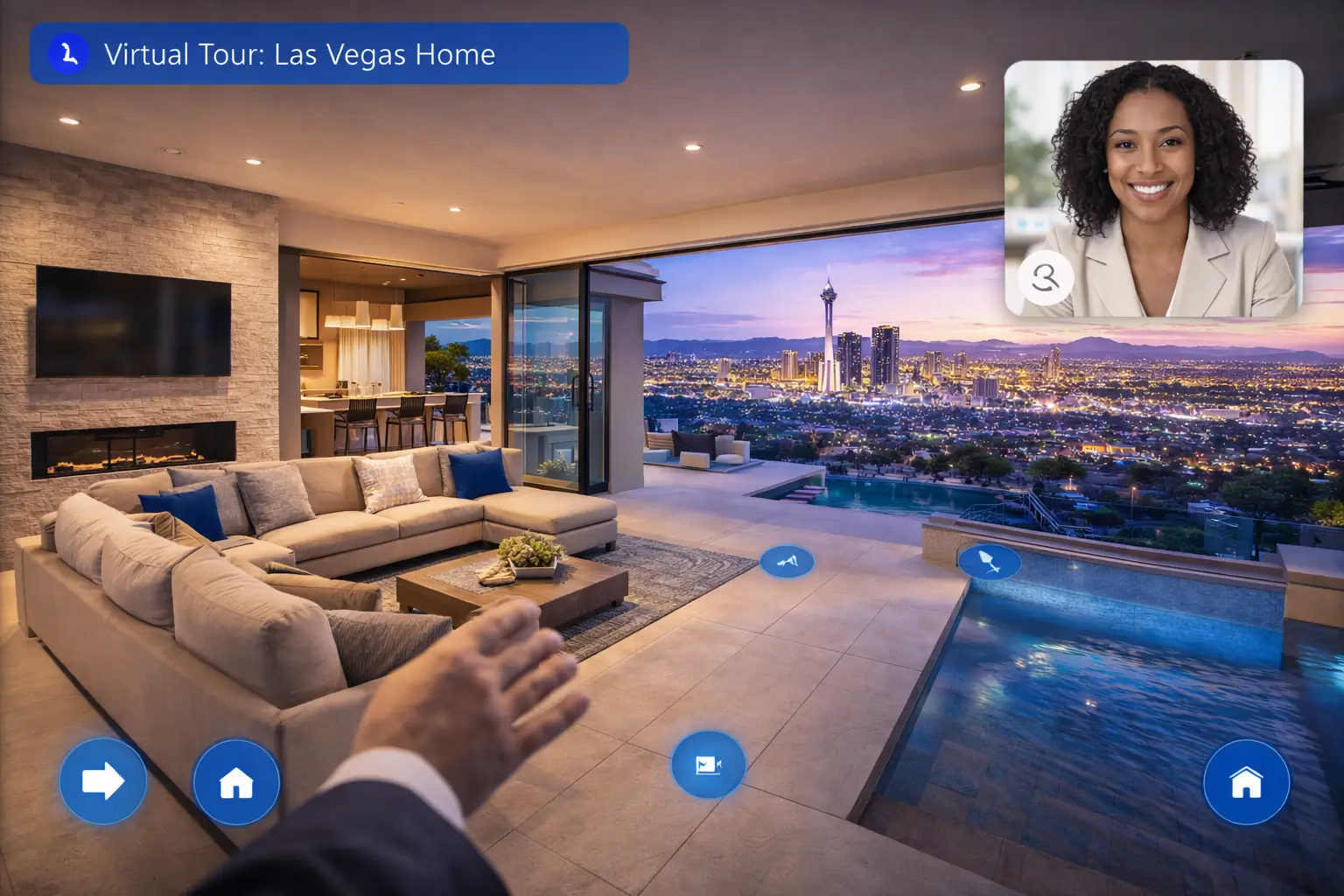
4) Stronger Offers From Out-of-State (And More “Sight-Unseen” Confidence)
Las Vegas has a constant stream of buyers who can’t easily tour in person: California, Pacific Northwest, Midwest relocations, and investors. These buyers don’t necessarily want to buy sight-unseen—but they will make decisions faster when they feel they’ve “been there” virtually.
A high-quality tour gives them:
-
Spatial confidence (flow, room sizes, transitions)
-
Condition confidence (finishes, maintenance, details)
-
Lifestyle clarity (yard, views, proximity feel)
What to expect:
More remote offers and more remote buyers who fly in for one day and only tour two homes—yours included—because the virtual tour earned that slot.
How to use it:
When you get remote interest, send the tour first, then follow with a short “guided tour” message:
“Watch especially: kitchen-to-living flow, primary bath remodel, backyard shade line, and the garage storage.”
You’re directing attention like a tour guide, not dumping a link like a robot.
5) Fewer Price Complaints Because the Tour Frames Value
Buyers complain more when they’re uncertain. Uncertainty makes people suspicious: “Why is it priced like this?” “What are they hiding?” “Are the rooms tiny?”
A good virtual tour reduces uncertainty. It frames the home clearly and honestly, which helps buyers anchor the price to what they’re seeing.
What to expect:
Fewer lowball offers that come from confusion, not strategy. More buyers who understand what they’re getting before they argue about it.
How to use it:
Pair the tour with smart listing copy that emphasizes tangible value: upgrades, layout advantages, lot size, view corridor, energy features, and neighborhood perks. In Vegas, “newer HVAC” and “paid solar” can be the difference between a tour lead and a hard pass.
6) Clearer Differentiation When Nearby Homes Look the Same
Vegas has plenty of neighborhoods where homes are… let’s call them “architecturally consistent.” Similar stucco, similar tile roofs, similar floorplans, similar upgrades. When everything looks the same in photos, the listing becomes a price war.
Virtual tours help your listing stand out by making the experience feel real. The buyer starts remembering this house, not just “one of the five beige ones.”
What to expect:
Better retention. More “I remember this one” energy. Less comparison shopping based purely on price per square foot.
How to use it:
When you market the tour on social media, don’t post it like a brochure. Post it like a story:
“Watch how this floorplan opens up—this is why people love this model.”
You’re selling the reason, not just the rooms.
7) A Long-Term Advantage: Virtual Tours Become Your Library of Proof
This one is bigger than a single listing. Over time, virtual tours become a portfolio. Not “pretty content,” but proof that you sell homes professionally.
When a homeowner asks, “What makes you different?” you can show them:
-
A consistent process
-
High-end presentation
-
The ability to attract remote buyers
-
A marketing standard they can see in seconds
That kind of proof builds trust fast—and trust is what wins listings.
What to expect:
Compounding returns. Each tour becomes an asset you can reuse in listing presentations, on your website, in ads, and in follow-up campaigns.
How to use it:
Organize your tours by area and price point:
-
Summerlin / Henderson / Southwest
-
Condos / luxury / investment properties
-
“Before & after” examples if you have them
That’s the old-school way to build a reputation—show your work.
The Bottom Line
Virtual tours don’t magically sell homes. They do something more useful: they remove friction from the buying process and remove noise from your lead flow.
In a market like Las Vegas—where buyers are often remote, time is limited, and competition is intense—virtual tours are the closest thing to a practical unfair advantage that doesn’t require you to become a dancing influencer.
Use them like a pro, and you can expect:
-
Better leads
-
Fewer wasted showings
-
Stronger remote buyer confidence
-
Cleaner pricing conversations
-
Better listing presentations
-
More differentiation
-
A portfolio that wins future business
The tour is the tool. Your strategy is what turns it into money.
Let’s Chat
Contact us to learn how 360° virtual tours can benefit your business.